theory
Twenty years ago, we first encountered anthropology on our first folklore expedition, which we joined at the invitation of friends from the conservatory. This chance event fundamentally changed the work and interest of our entire lives. What was it about anthropology that attracted and infected us so much? The process of anthropological research itself, outside of academic tasks, is a contemplative, attentive, engaged observation of a person—and, as a consequence, an attempt to convey a fragment of culture through a private story. This process also acquired value from the perspective of personal motivation.
Studying another person in close proximity helps to understand oneself and contributes to the formulation of one’s own identity. Over time, the multisensory study of cultures and communities became a reason to talk about important topics—from the perspective of heritage and society. The materials from our expeditions began to turn into books, online exhibitions, and physical exhibition projects.
The very specificity of anthropological material automatically solves the task of establishing a connection with the viewer. Another person’s story is symmetrical to the viewer—it easily reflects their private experience, and therefore, evokes parallels in the imagination and memory. It is much easier for a viewer to compare their experience with that of another person than with an object, a display case, or a scientific text. Discovering this commonality allows for the building of a quality relationship with heritage and with the narrative in the exhibition.
Anthropology first became a pretext, and then—an instrument for integrating human stories into our projects.
Studying another person in close proximity helps to understand oneself and contributes to the formulation of one’s own identity. Over time, the multisensory study of cultures and communities became a reason to talk about important topics—from the perspective of heritage and society. The materials from our expeditions began to turn into books, online exhibitions, and physical exhibition projects.
The very specificity of anthropological material automatically solves the task of establishing a connection with the viewer. Another person’s story is symmetrical to the viewer—it easily reflects their private experience, and therefore, evokes parallels in the imagination and memory. It is much easier for a viewer to compare their experience with that of another person than with an object, a display case, or a scientific text. Discovering this commonality allows for the building of a quality relationship with heritage and with the narrative in the exhibition.
Anthropology first became a pretext, and then—an instrument for integrating human stories into our projects.
ram case

Use the scrollbar to read the case
Exhibition "Letters to God"
Here we want to give an example from our projects. In one of the halls, a collection of prayer rugs was displayed, gathered based on the principle of their "animation"—the rugs bore traces, imprints, signs of the performance of namaz, the Islamic prayer. These rugs were combined with the stories of contemporary people about how they feel their connection with God. This contrast between the physical trace and the inner experience built a voluminous, multi-layered project.
Here we want to give an example from our projects. In one of the halls, a collection of prayer rugs was displayed, gathered based on the principle of their "animation"—the rugs bore traces, imprints, signs of the performance of namaz, the Islamic prayer. These rugs were combined with the stories of contemporary people about how they feel their connection with God. This contrast between the physical trace and the inner experience built a voluminous, multi-layered project.
example
At the 2024 Venice Biennale, the Mexican artist of German-Lebanese descent, Erick Meyenberg, presented the project Nos marchábamos, regresábamos siempre ("We would leave, we would always return"), created in collaboration with the Doda family—Albanian migrants who moved to Italy more than 30 years ago. The installation combined video, soundscapes, and sculptural objects that reference domestic and ritual culture, creating a multi-layered space of personal and collective memory.
On the one hand, we saw a documentation of their family celebration, incredibly beautifully shot, almost cinematic. And on the other, a huge installation in the form of a ceramic feast. The viewer literally sat at this table. Simultaneously—the objects, the family’s life, and a separate audio track—all of this came together into a powerful experience. This work, strangely enough, did not receive wide attention in the professional community, but it remained memorable for us.
On the one hand, we saw a documentation of their family celebration, incredibly beautifully shot, almost cinematic. And on the other, a huge installation in the form of a ceramic feast. The viewer literally sat at this table. Simultaneously—the objects, the family’s life, and a separate audio track—all of this came together into a powerful experience. This work, strangely enough, did not receive wide attention in the professional community, but it remained memorable for us.
theory
6.1
The Person is at the Center
In exhibition design, we talk about the importance of an anthropocentric approach. Why? On the one hand, focusing on a person’s private experience reflects a product-oriented approach and is an obvious bridge to user scenarios—after all, they are created for a person. On the other hand, a personal story and specific experience become crucial tools for creating dialogue and an emotional connection with the viewer.
This approach becomes especially significant when working with object-based heritage—things devoid of physicality, perceived without context, events, and experiences in the viewer’s perception.
This approach becomes especially significant when working with object-based heritage—things devoid of physicality, perceived without context, events, and experiences in the viewer’s perception.

6.1.1
Behind any object—even from the most distant past—we acknowledge the presence of a person. In institutional and home archives, archaeologists' diaries, ethnographers' field notes, it is important to try to find a plot or a small destiny associated with this owner or user of the object.
Even if you are working with a historical or archaeological theme in an exhibition, with object-based and spiritual heritage belonging to the distant past, it may be appropriate to supplement the narrative with research on contemporaries. This will allow for a new layer of reading the heritage, create dimensionality in the representation, and update the theme in the present time. The angle of the research conducted can be directly or indirectly related to one of the exhibition’s lines.
Ways to integrate a person into an exhibition:
1/ Animating the object
2/ esearching contemporaries
ram case
"Four Lines" Installation
The exhibition "Meeting in Kazan" displayed a rich collection of the material heritage of the Kazan Tatars from the 11th-20th centuries. A series of decorative and applied art objects was divided into chapters defining the areas of life of the city’s inhabitants. We created an installation about the poetic folklore tradition. It related to a special form of four-line versification, where in the first two lines a person’s feelings were presented through images of the natural world, and only in the last two did the author’s voice appear. Such a tradition was associated with a culture of restraint in expressing feelings.
The exhibition "Meeting in Kazan" displayed a rich collection of the material heritage of the Kazan Tatars from the 11th-20th centuries. A series of decorative and applied art objects was divided into chapters defining the areas of life of the city’s inhabitants. We created an installation about the poetic folklore tradition. It related to a special form of four-line versification, where in the first two lines a person’s feelings were presented through images of the natural world, and only in the last two did the author’s voice appear. Such a tradition was associated with a culture of restraint in expressing feelings.
Use the scrollbar to read the case
We conducted a co-creative lab with young residents of Kazan. During the lab, the participants searched for visual and sound images through which they could express the most important experiences in their lives. The installation included a video sequence with portraits of teenagers, texts about their worries, and urban images expressing them. In one of the halls with object-based heritage, we also placed a screen showing the live process of the lab. The contrast between the ancient objects and the sudden video with teenagers created, on the one hand, surprise, and on the other—a connection with the present day. In the final hall of the exhibition, the installation showed the commonality of the tradition and the viewer through the theme of the manifestation of emotions.
theory
6.1.1
A co-creative lab implies that you invite not an academic audience into the joint research process, but carriers of culture or knowledge. In such labs, your task shifts towards creating a context and an algorithm for interaction. Through formats of interviews, archival searches, brainstorms, or even performative practices, participants search for answers to the questions posed and document the process. The substantive outcome of such labs can be not only the textual and visual contributions of the participants but also the documentation of the process itself.
This research approach involves the creation of content by users, and in our case—by viewers. Such research can be implemented in both online and offline environments. The main task is to create an "interface" through which viewers can share textual, sound, or visual materials in response to a given topic. You can survey people with specific experience or turn to people’s home archives before the exhibition opens—and even include the materials obtained in it. You can also collect viewers' reflections on one of your project’s questions and show it in the main part of the exhibition. Such an approach significantly increases the potential for deep and sincere engagement.
Ways to integrate a person into an exhibition:
3/ Conducting co-creative labs
4/ UGC (user-generated content)
example
In 2019, the Moscow Museum of Modern Art hosted Yoko Ono’s exhibition "The Sky is Always Clear," which featured the interactive installation "Arising." The artist invited women from all over the world to anonymously share stories of moral or physical abuse and to send photographs of their eyes. These stories were displayed on an interactive cube in the exhibition. Female visitors had the opportunity to leave their stories through a special form on the museum’s website, and many stories were processed and shown in this way.
ram case
"Canned Food and Dreams" Installation
How did we bring spoiled canned food to life? Sometimes, museum collections contain unusual treasures. In the local history museum of Slantsy, during a renovation, the keepers discovered six boxes of canned food—borscht, cranberry juice, apple jam, "Buratino" and "Sitro" sodas, solyanka, and blueberry jam. Apparently, around the 70s, the museum asked the Slantsy cannery to donate these artifacts of culinary tradition to their collection.
How did we bring spoiled canned food to life? Sometimes, museum collections contain unusual treasures. In the local history museum of Slantsy, during a renovation, the keepers discovered six boxes of canned food—borscht, cranberry juice, apple jam, "Buratino" and "Sitro" sodas, solyanka, and blueberry jam. Apparently, around the 70s, the museum asked the Slantsy cannery to donate these artifacts of culinary tradition to their collection.
The contents of the cans had long since spoiled. Some liquids had completely dried up, the kissel had turned to sand, the jam had taken the form of crystals, the soup and main dishes looked like soil samples. Inside some cans, only brown stains remained. Thus, a rhyme with memories was born. Is everything we keep in our memory fresh and edible? If it’s spoiled or rotten, smells bad or has gone off—should such memories be thrown away? What should be kept? How to turn trauma into a postcard that you would be happy to receive in the future? And maybe something really does need to be thrown away?
Use the scrollbar to read the case
We drew a parallel between the contents of the cans and memories and began to collect stories from the residents of Slantsy about how they remember the past. We placed the cans under transparent cubic covers, creating a sterile shell for them. While examining the dried currants and the mold on the shchi, viewers heard monologues in their headphones about family rituals, childhood games, and favorite treats, which in the end turn into a confession. In the words, one could feel doubt: why do I keep this in my memory? how did I live through this? why do I remember this? do I want to remember this? why did I live as if it never happened?
theory
6.2
Why Do We Listen to Stories?
When we cry at the movies or smile over a book, we see in them a reflection of our own memories and worries. The character becomes our mirror, in which we recognize our own lived experience.
A story prompts a person to empathy and helps to realize a sensory connection with the subject. The conflict and events happening to the characters cause an internal dialogue, and therefore—ensure interactivity.
A story also forms navigation in a physical space because it literally leads a person and creates the logic of their user experience.
The presence of a person helps to fill the gaps between the new and the old, the modern and the passing, between the documentary and the fictional. The person and their experiences become a mediator.
Storytelling is a way of transmitting knowledge. What distinguishes a story from a news report, a social media post, or a description of a museum object’s provenance? It is important to note that each of these genres has the potential to become a story.
What does a story consist of?
A story prompts a person to empathy and helps to realize a sensory connection with the subject. The conflict and events happening to the characters cause an internal dialogue, and therefore—ensure interactivity.
A story also forms navigation in a physical space because it literally leads a person and creates the logic of their user experience.
The presence of a person helps to fill the gaps between the new and the old, the modern and the passing, between the documentary and the fictional. The person and their experiences become a mediator.
Storytelling is a way of transmitting knowledge. What distinguishes a story from a news report, a social media post, or a description of a museum object’s provenance? It is important to note that each of these genres has the potential to become a story.
What does a story consist of?
- Character (protagonist / subject)
- Problematics
- Entry point and exit point (beginning / end)
- Development
Character (protagonist / subject)
6.2.1
The character or protagonist of the narrative serves as a guide. It is with them that the viewer identifies and, thanks to this, is able to experience feelings, impressions, and, as a consequence, react to the content during and after its perception. Even if the viewer’s personal experience is in no way connected with the project’s theme, the very figure of the character awakens empathy and a sense of involvement.
A character can be a person or a group of people. A thing or a territory, for example, a city, can also act in this role. It is important that the character takes on the role of the viewer’s companion and responds to all the questions and emotions that arise in them during the viewing. Whether they are animate or not—it is important to treat their description as if they were alive, feeling, and experiencing.
A character can be a person or a group of people. A thing or a territory, for example, a city, can also act in this role. It is important that the character takes on the role of the viewer’s companion and responds to all the questions and emotions that arise in them during the viewing. Whether they are animate or not—it is important to treat their description as if they were alive, feeling, and experiencing.
example
In Laurie Anderson’s film "Heart of a Dog," the main character is a dog. Despite the fact that she cannot speak, it is her behavior and emotions that become the main thread along which the viewer’s attention moves.
theory
problematics
6.2.2
If you recall any fairy tale, it will certainly have villains and all sorts of obstacles. All archetypal plots without exception contain the main character’s overcoming of trials. Have you ever wondered why human nature so needs dramatic events and why no film can do without them—even in the comedy genre?
Probably, everything produced by man is, to some extent, an attempt to reconcile with reality, in particular—with the finitude of being. The finitude of relationships, events, weather phenomena, and ultimately life itself. Death as the ultimate form of finitude becomes the strongest driver of motivation, goal-setting, and perception of information.
Probably, everything produced by man is, to some extent, an attempt to reconcile with reality, in particular—with the finitude of being. The finitude of relationships, events, weather phenomena, and ultimately life itself. Death as the ultimate form of finitude becomes the strongest driver of motivation, goal-setting, and perception of information.
We are driven by the fact of realizing the finitude of life
problematics
6.2.2
In a story, on the character’s path, there are obstacles, helpers, enemies. They are driven by some big dream or idea. Throughout the story, we watch as the character makes their way through the unknown, only to witness with them at the end a positive or negative resolution of the situation. The essence of telling a human story is not to get to point B, but to make the journey between A and B together with the protagonist. We are not so much interested in enjoying the fact itself; we are probably more interested in following the process of embodiment, transformation, transfiguration. In this, there is a closeness to the plot of Creation.
When constructing a story, we need problematics, an obstacle, a trial. This makes it possible to create tension, which, in turn, provokes attention and empathy. There is another significant property in observing dramatic events. Observing a painful experience in a work of art normalizes for a person the presence of deep traumatic experiences in their life—that is, it literally provides them with healing support.
When constructing a story, we need problematics, an obstacle, a trial. This makes it possible to create tension, which, in turn, provokes attention and empathy. There is another significant property in observing dramatic events. Observing a painful experience in a work of art normalizes for a person the presence of deep traumatic experiences in their life—that is, it literally provides them with healing support.
Entry and Exit Points
6.2.3
The entry point and exit point are the most responsible moments of a story.
The entry point is responsible for the initial focus of attention and the viewer’s engagement. How we organize the beginning of the project and its first moments determines whether the viewer will stay in our story or leave it immediately.
The exit point, in turn, is responsible for what happens to the viewer after they finish viewing—close the laptop lid or leave the exhibition space, get busy with other things, get on a bus and go to another city. Our task is to prompt the viewer to certain thoughts and/or actions and to achieve the effects we have planned. The exit is the key accent, responsible for what the viewer will return to the real world with after immersing themselves in our story.
In the case of sensitive topics, the entry and exit points become especially important: how to let the viewer into the story without scaring or pushing them away? How to correctly and, at the same time, significantly form the main message and emotion with which the viewer will exit the narrative?
The entry point is responsible for the initial focus of attention and the viewer’s engagement. How we organize the beginning of the project and its first moments determines whether the viewer will stay in our story or leave it immediately.
The exit point, in turn, is responsible for what happens to the viewer after they finish viewing—close the laptop lid or leave the exhibition space, get busy with other things, get on a bus and go to another city. Our task is to prompt the viewer to certain thoughts and/or actions and to achieve the effects we have planned. The exit is the key accent, responsible for what the viewer will return to the real world with after immersing themselves in our story.
In the case of sensitive topics, the entry and exit points become especially important: how to let the viewer into the story without scaring or pushing them away? How to correctly and, at the same time, significantly form the main message and emotion with which the viewer will exit the narrative?
Development
6.2.4
If the entry and exit points are similar to the exposition and resolution we are familiar with from fairy tales, then development is everything that at every moment moves the viewer forward through the narrative, regardless of whether it is linear or not. Development affects the viewer’s perception, their decision to stay inside a complex topic or to exit it indifferent.
Our task, of course, is to maintain the viewer’s interest and engagement within the story and to bring them to the exit point filled with the meanings that are important for us to convey to them.
Our task, of course, is to maintain the viewer’s interest and engagement within the story and to bring them to the exit point filled with the meanings that are important for us to convey to them.
Drivers for creating dynamics:
6.2.5
Composition — the arrangement of elements and their parts.
3
Rhythm — frequency and length.
2
1
Speed — time intervals between and within elements.
Development is responsible for dynamics: what rhythm and pace are embedded both in the overall narrative and within each fragment. We control dynamics with certain drivers.
Saturation can be expressed in the color, light, and form of elements. Just as a sentence can consist of one word or even a letter, so an image—be it a photograph or a video—can be slow, smooth, quiet, or it can be sharp, fast, or pulsating. You have probably noticed how differently two video clips of the same duration but different content can be perceived.
Imagine that for two minutes, old people are pushing a wagon along a snowy road in the frame. Or we see footage from a nightclub for the same period of time, two minutes. In the first case, time will pass much more slowly for us than in the second, because the saturation with events, forms, objects, light will be much more intense in the nightclub than in the snowy field. The same thing happens with a multimedia composition.
Saturation can be expressed in the color, light, and form of elements. Just as a sentence can consist of one word or even a letter, so an image—be it a photograph or a video—can be slow, smooth, quiet, or it can be sharp, fast, or pulsating. You have probably noticed how differently two video clips of the same duration but different content can be perceived.
Imagine that for two minutes, old people are pushing a wagon along a snowy road in the frame. Or we see footage from a nightclub for the same period of time, two minutes. In the first case, time will pass much more slowly for us than in the second, because the saturation with events, forms, objects, light will be much more intense in the nightclub than in the snowy field. The same thing happens with a multimedia composition.
example
Bread Day, 1998
Sergei Dvortsevoy
Sergei Dvortsevoy
theory
Drivers for creating dynamics:
6.2.4
A change in rhythm saves the viewer from content fatigue. It is important for us to preserve the significance and conscious perception of each block of the story to prevent mechanical scrolling in an online project or a quick run-through of the space of a physical exhibition. We must encourage the viewer to be constantly engaged and to provoke in them a literal hunger and curiosity for each subsequent episode of the story.
example
A good illustration of rhythmic dynamics would be a project implemented using interactive 3D technologies and virtual reality, where from the very first minute of immersion, the viewer feels strong tension. Being in the location of the story’s plot creates a truly immersive experience.
theory
Drivers for creating dynamics:
6.2.4
With the advent of multimedia, managing dynamics has become much easier, as the choice of expressive means has become significantly wider. Imagine how difficult it is to solve this task in a 450-page novel—to maintain the reader’s attention and hold their interest.
In multimedia projects, just by alternating different types of media, we already change the rhythm and switch the mechanics of the viewer’s perception. However, a mere variety of tools does not always mean good dynamics and audience engagement.
Like writing a recipe for a dish, there is a certain sequence in preparing the ingredients and patterns of product combinations. We follow them so that the taste turns out exactly as we intend it.
The development of the plot within a story must be designed, planning and predicting certain reactions of the viewer at every moment of their time. This design can be compared to an emotional cardiogram, in which we mark ups and downs, shocks and joy, worries and silence. Based on this emotional map, we build the narrative sequence, select certain media fragments, and edit each of them.
When creating scenarios for the viewer’s emotional dynamics, it is especially important not to abuse their sensitivity. When working with vulnerable topics, one must avoid manipulation, not use the fragile and traumatic experiences of the participants as a tool of influence. The designer’s task is to maintain a balance between emotional engagement, sincerity, and ethics.
In multimedia projects, just by alternating different types of media, we already change the rhythm and switch the mechanics of the viewer’s perception. However, a mere variety of tools does not always mean good dynamics and audience engagement.
Like writing a recipe for a dish, there is a certain sequence in preparing the ingredients and patterns of product combinations. We follow them so that the taste turns out exactly as we intend it.
The development of the plot within a story must be designed, planning and predicting certain reactions of the viewer at every moment of their time. This design can be compared to an emotional cardiogram, in which we mark ups and downs, shocks and joy, worries and silence. Based on this emotional map, we build the narrative sequence, select certain media fragments, and edit each of them.
When creating scenarios for the viewer’s emotional dynamics, it is especially important not to abuse their sensitivity. When working with vulnerable topics, one must avoid manipulation, not use the fragile and traumatic experiences of the participants as a tool of influence. The designer’s task is to maintain a balance between emotional engagement, sincerity, and ethics.
6.3
Pillars of the Story
Let’s try to briefly summarize all those key features that influence the design of a story and prompt the viewer to a deep and meaningful experience.
Idea. Through what key will you reveal your topic in depth and breadth?
1
2
3
Image. What do you associate the processes / phenomena / protagonists / meanings of your project with?
Protagonist. Who are your protagonists and in what ways do you reveal them as characters?
Aesthetics. How do you ensure beauty and visual integrity within the project?
4
Logic. Why will your story be understandable to the viewer? Through what plot points do you guide them from the entry point to the exit point?
5
Voice. How is the story humanized to get closer to the viewer?
8
Emotional content. What pain points connect the story and the viewer?
Vision. What is the central meaning and point of view of your story?
Dramaturgy. What key question continuously leads the viewer through the entire story?
7
6
9
10
11
Economy. How to present the content as concisely as possible, without overloading the viewer with an excess volume of material?
Synthesis of materials. By what means can the story be supported and made more voluminous?
Dynamics. How will you change the rhythm of the story to maintain the viewer's concentration on the content?
12
Structure. How do you structure the narrative at the level of form: what blocks does it consist of, in what sequence are the fragments presented, how are the transitions between them arranged?
13
method
Illustrations of the method:
The resulting and selected stories became symbolic plots for each research project and were turned into chapters of the exhibition.
This allowed for the structuring of the entire substantive part of the fieldwork and for a selection of the events that took place, not just academic hypotheses. The narratives were both poetic and descriptive; both global and very private. Such a variety of plots allows for the building of both the general framework of the exhibition and its individual, even the smallest, elements—for example, labels.
things in common
Narrative chains
Some of the participants' research projects lasted for more than ten years. Therefore, it was very difficult for the authors to create a coherent structure, to choose the main messages and key characters. We came up with and offered the researchers the method of narrative chains, which we now often use and which found a very lively response among the scientists.
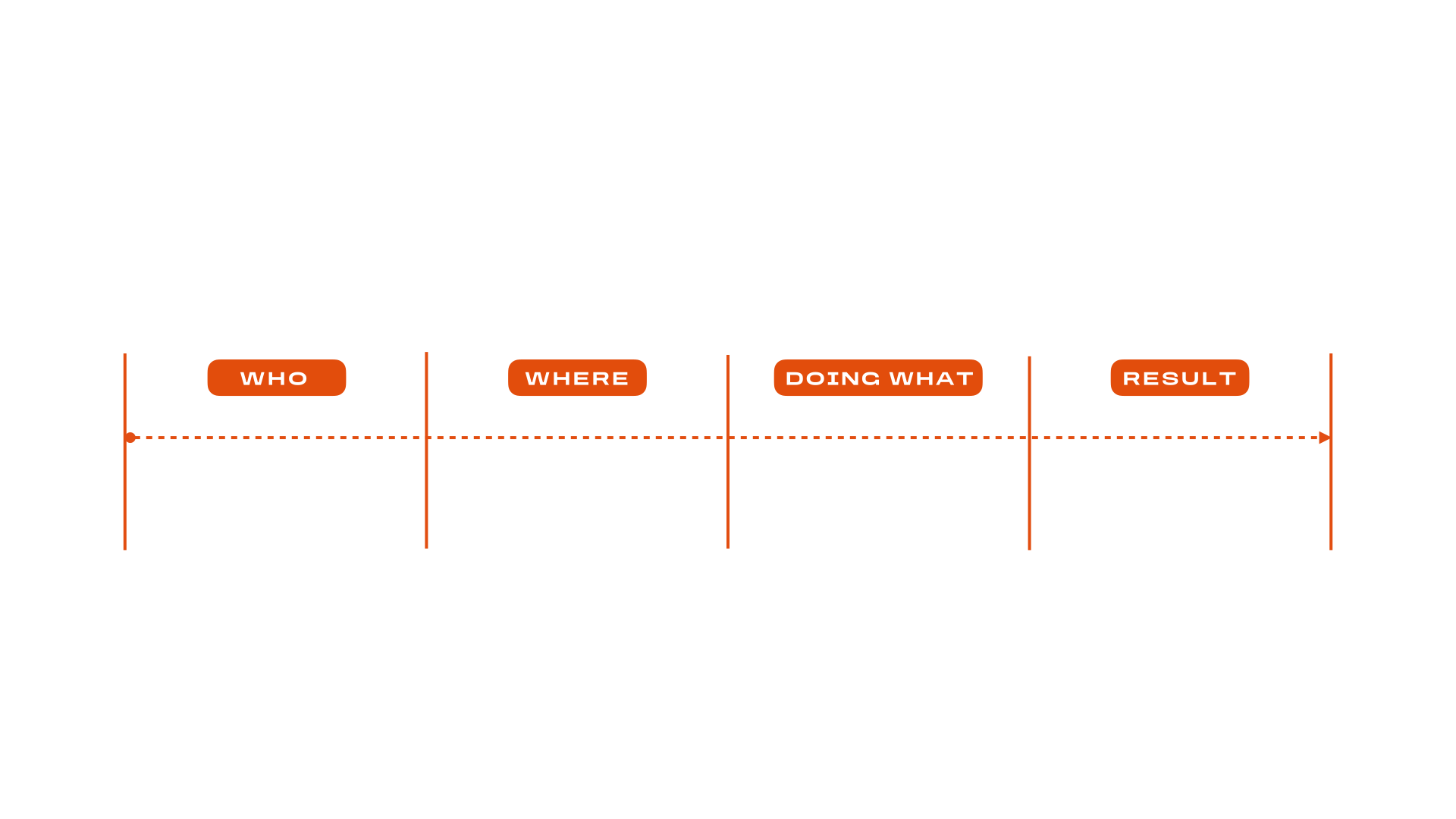
The scheme itself has a simple table form with four columns:
We suggested that the researchers fill out this table in a stream-of-consciousness mode: without setting priorities and without evaluating the scale and significance of the narrative.
Some of the participants' research projects lasted for more than ten years. Therefore, it was very difficult for the authors to create a coherent structure, to choose the main messages and key characters. We came up with and offered the researchers the method of narrative chains, which we now often use and which found a very lively response among the scientists.
The scheme itself has a simple table form with four columns:
- who?
- where?
- doing what?
- what is the result?
We suggested that the researchers fill out this table in a stream-of-consciousness mode: without setting priorities and without evaluating the scale and significance of the narrative.