theory
Imagine you’ve bought a ticket at the box office and are heading into the exhibition. Your trajectory of movement from entrance to exit—this is the user journey. All the events that happen to you: reading labels, using furniture, listening to audio tracks, unconsciously moving through the space—make up this journey. When designing an exhibition, it’s important to create it in such a way that the viewer receives all the key values, experiences, and knowledge defined at the project’s goal-setting stage.
5.1
Design is the Forecasting of Events
A significant disciplinary area of representation is communication design. Its task is to create a product in such a way that the planned communicative effect takes place. An advertisement for lemonade depicts a person in the desert to awaken a sense of thirst in the viewer and create a desire to buy the drink.
To build a path, to lead the viewer from point A to point B with a given effect—this is the task of creating a user journey. At each point along it, one must anticipate a multitude of options for the user’s physical, emotional, and psychological reactions. Based on an understanding of these reactions, we proactively search for a response to them.
A person finds themselves in a room with two doors. If we want them to follow a specific route, we create navigational cues. If, on the contrary, we want them to choose for themselves and even experience confusion, we deliberately do not mark the doors. In any case, we must calculate all possible behavioral scenarios and provide for them. In this sense, design is the forecasting of events.
To build a path, to lead the viewer from point A to point B with a given effect—this is the task of creating a user journey. At each point along it, one must anticipate a multitude of options for the user’s physical, emotional, and psychological reactions. Based on an understanding of these reactions, we proactively search for a response to them.
A person finds themselves in a room with two doors. If we want them to follow a specific route, we create navigational cues. If, on the contrary, we want them to choose for themselves and even experience confusion, we deliberately do not mark the doors. In any case, we must calculate all possible behavioral scenarios and provide for them. In this sense, design is the forecasting of events.
Design is the Forecasting of Events
The ability to anticipate and respond to human behavior is a manifestation of a high humane culture. Here we return again to the concept of caring for the person. We can design not only the viewer’s physical reactions but also their cognitive, emotional, and psychophysical processes: prompting reflections on childhood, creating a desire to write a message to one’s mother, or, for example, to provide humanitarian aid. Therefore, we say: design creates relationships.
create an attitude
to the topic
to heritage
to the world
to the topic
to heritage
to the world
This logical task can be called a fascinating mathematical challenge. Or even a game of chess.
5.2
The Interface of Scientific Knowledge
One day, the word "interface" came to our minds precisely in the context of scientific communication. Representation is often called packaging. But the fundamental mistake is that packaging is a detachable shell. What do we do with a juice box or a candy wrapper? We throw it away.
An interface, however, is inseparable from the content. It is directly connected to it: through algorithms, wires, program code. Therefore, we chose the word "interface" as more accurate for describing representation. By developing an interface for scientific knowledge, we create a living shell that continues the substance of the content. An important feature of an interface is interactivity: it elicits a reaction from the user, invites responsive actions—gestures, reactions, data transmission, and even content editing.
When you use an application or the control panel of a home appliance, your satisfaction depends on several factors.
An interface, however, is inseparable from the content. It is directly connected to it: through algorithms, wires, program code. Therefore, we chose the word "interface" as more accurate for describing representation. By developing an interface for scientific knowledge, we create a living shell that continues the substance of the content. An important feature of an interface is interactivity: it elicits a reaction from the user, invites responsive actions—gestures, reactions, data transmission, and even content editing.
When you use an application or the control panel of a home appliance, your satisfaction depends on several factors.

Transparency—actions are intuitively understandable, the user sees the path to solving the task.
1
2
3
Communicative correspondence—the linguistic style, tone, and visual images do not cause rejection.
Convenience / user-friendliness—the task is solved in minimum time and with a minimum number of iterations.
Adaptability—the interface adapts to conditions and devices.
4
Predictability—the interaction experience does not diverge from expectations.
5
5.2.1
Features of a quality interface:
5.3
The Three Journeys
When designing interfaces, we are actually designing a trilogy, three parallel lines: the physical, emotional, and intellectual experience of a person.
What did they feel—how did they experience, laugh, smile, get upset on their route from point A to point B? What knowledge entered their head during the movement? What did they learn, what did they remember? What gestures did they make, how did they move, where did they linger?
A person can go right, left, slowly or quickly—it doesn't matter. But ultimately, all of this collapses into a unique "cardiogram"—the pattern of personal experience.
Throughout the entire length of the exhibition—both for the assimilation of information, for maintaining attention, and for creating a deep experience—it is important to alternate rhythms and intonations. It is important to avoid monotony.
What did they feel—how did they experience, laugh, smile, get upset on their route from point A to point B? What knowledge entered their head during the movement? What did they learn, what did they remember? What gestures did they make, how did they move, where did they linger?
A person can go right, left, slowly or quickly—it doesn't matter. But ultimately, all of this collapses into a unique "cardiogram"—the pattern of personal experience.
Throughout the entire length of the exhibition—both for the assimilation of information, for maintaining attention, and for creating a deep experience—it is important to alternate rhythms and intonations. It is important to avoid monotony.
The emotional journey can be compared to a cardiogram. It can be represented as a rhythmic pattern or even a score. The alternation of pauses, strong emotional episodes, moments of contemplation, and dramatically charged scenes are strung together and form the fabric of the viewer's emotional experience.
Intellectual
This is the sequence of all the viewer's movements and gestures in the space. The physical route is constructed using environmental and informational media. Architectural forms, exhibition equipment, and lighting set the viewer's trajectory of movement. A significant parameter here is also speed: in which zones and for how long the viewer lingers, how the pace of their movement changes. All of this is regulated by environmental solutions and directly affects the other two levels of the user journey.
Emotional
Physical
Imagine a text document that contains all the content of the exhibition. All informational elements without exception: curatorial texts, object descriptions, labels, video subtitles, photo captions, and so on. Let’s try to highlight the main meanings in this text, to mark the levels of information—historical references, personal diaries, chronologies. What do we want to leave in the viewer’s memory after they leave the exhibition? How data is structured in perception and memory, which of it turns into knowledge and is retained after contact with the exhibition ends—this is the intellectual journey.
The viewer’s experience is manifested both in the environment and in material and non-material objects, in the architecture, in the smell. Each person has an individual route. One could even assume that no two are identical, if you look at them with full attention. This is the sequence of all physical and psycho-emotional states in the exhibition—at every moment in time.
ram case
"Will it Disappear or Transform" Exhibition
Physical Journey
The architecture of the exhibition symmetrically reflected the structure, consisting of five chapters. Each chapter was dedicated to one family and the tradition that is preserved, destroyed, or transformed over several generations. Each chapter was represented by a conditional room that did not imitate a dwelling, but rather outlined a space for the interaction of objects, archives, projections—through which system we immersed ourselves in the family's history. We did not plan a precise route. The navigation was based on the metaphor of wandering: we wanted viewers to occasionally turn "the wrong way"—hitting dead ends or voids, and sometimes to be able to stumble upon a conditional "courtyard" where they could rest.
Physical Journey
The architecture of the exhibition symmetrically reflected the structure, consisting of five chapters. Each chapter was dedicated to one family and the tradition that is preserved, destroyed, or transformed over several generations. Each chapter was represented by a conditional room that did not imitate a dwelling, but rather outlined a space for the interaction of objects, archives, projections—through which system we immersed ourselves in the family's history. We did not plan a precise route. The navigation was based on the metaphor of wandering: we wanted viewers to occasionally turn "the wrong way"—hitting dead ends or voids, and sometimes to be able to stumble upon a conditional "courtyard" where they could rest.
Emotional Journey
In the scenography of the exhibition, we tried to convey the state of a researcher who has arrived in an unfamiliar village for the first time. He walks the streets, listens to voices, looks at the glimmers of light in the windows. He knocks on doors, talks with local residents, tries to build a trusting conversation. He is characterized by uncertainty and confusion; he is happy when someone opens the door for him and answers his questions. He feels cozy and joyful when one of the residents throws open the doors of their home and caringly invites him for tea and pie. The general background of the exhibition was transparent and dark, and the main stories, faces, and objects were highlighted with soft spots of light—and served as a kind of navigation in the space. The viewer had to move not along a set route, but as if bouncing off these highlighted semantic objects.
In the scenography of the exhibition, we tried to convey the state of a researcher who has arrived in an unfamiliar village for the first time. He walks the streets, listens to voices, looks at the glimmers of light in the windows. He knocks on doors, talks with local residents, tries to build a trusting conversation. He is characterized by uncertainty and confusion; he is happy when someone opens the door for him and answers his questions. He feels cozy and joyful when one of the residents throws open the doors of their home and caringly invites him for tea and pie. The general background of the exhibition was transparent and dark, and the main stories, faces, and objects were highlighted with soft spots of light—and served as a kind of navigation in the space. The viewer had to move not along a set route, but as if bouncing off these highlighted semantic objects.
Use the scrollbar to read the case
Intellectual Journey
In contrast to the disordered and more intuitive physical and emotional journeys, the intellectual route was built on contrast—very structured, clear, and even dry. In predictable, always identical places and media, the viewer found themselves in front of explanatory texts that connected all 5 chapters and provided clues for interpreting each story. Thus, the viewer formed a clear narrative in form: about five families and their traditions, about the key episodes that happened with this tradition, and comments on each object seen.
In contrast to the disordered and more intuitive physical and emotional journeys, the intellectual route was built on contrast—very structured, clear, and even dry. In predictable, always identical places and media, the viewer found themselves in front of explanatory texts that connected all 5 chapters and provided clues for interpreting each story. Thus, the viewer formed a clear narrative in form: about five families and their traditions, about the key episodes that happened with this tradition, and comments on each object seen.
theory
5.4
Pre-tests
When we talk about an exhibition’s interface, we are designing all types of events and human interaction with the content. How does a person move through the space? Where do they stop, where do they turn? Which fragments of the exhibition do they leave unattended and why? Perhaps they didn’t understand that another room was hidden around the corner and they needed to turn there. This means we forgot to put the necessary sign or some visual cue in that place. To protect the exhibition from such scenic failures, it is necessary to conduct pre-tests. Here, the parallel with testing software products becomes significant for us.
One of the first stages of testing the viewer experience is prototyping all information carriers. Such an approach not only allows for checking and refining the user experience but also saves the budget. It is recommended to print all levels of the exhibition’s content elements on plain paper in a black-and-white version at a 1:1 scale and place them in the space exactly where they are planned.
One of the first stages of testing the viewer experience is prototyping all information carriers. Such an approach not only allows for checking and refining the user experience but also saves the budget. It is recommended to print all levels of the exhibition’s content elements on plain paper in a black-and-white version at a 1:1 scale and place them in the space exactly where they are planned.
Checking the scale, visibility, and readability of all elements.
1
2
3
Ensuring the accuracy of the chosen locations and their placement in the space.
Checking the integrity of the content—how logically and sufficiently all fragments come together.
Playing out all angles of the exhibition's unfolding as one moves through the space.
4
5.4.1
A pre-test allows for:
We test the exhibition with steps and turns of the head
An effective tool for testing an exhibition can be the recording of an individual viewer's experience. The pre-test participant goes into the exhibition and writes down everything that happens to them in a notebook: what they remembered, what impressed them, what they thought while looking at a particular exhibit. Such records can become an exceptionally useful guide for significant qualitative changes in the exhibition.
ram case

Use the scrollbar to read the case
"Will it Disappear or Transform" Exhibition
One of the chapters was dedicated to the Tatar Isaev family and their successive tradition of collecting and preserving their family archive. The documents of this archive, as well as objects, were placed in suspended semi-transparent boxes, which the team and I nicknamed "birdhouses." The scenario was constructed so that the viewer would penetrate inside each repository—examining the material fragments of family memory and listening to the voices of sister and brother Isaev, telling the family stories.
One of the chapters was dedicated to the Tatar Isaev family and their successive tradition of collecting and preserving their family archive. The documents of this archive, as well as objects, were placed in suspended semi-transparent boxes, which the team and I nicknamed "birdhouses." The scenario was constructed so that the viewer would penetrate inside each repository—examining the material fragments of family memory and listening to the voices of sister and brother Isaev, telling the family stories.
Inside each box, a speaker and a light source were hidden. The viewer needed to slightly open the curtain of each box and literally dive headfirst into the archive to hear the audio monologues and examine the documents. The scenario of the viewer’s interaction with the content continued the idea of the entire exhibition—a delicate, intimate, private touch to human memory. Every detail in the design of the "birdhouses" was important to us: the scales and proportions, the intensity of the light, the degree of transparency of the documents, the inaudibility of the voice until a certain level of proximity, the tactile sensations from touching the curtain—its warm texture.
method
Block 1: Storytelling
Block 2: Experience — Knowledge & Emotions
things in common
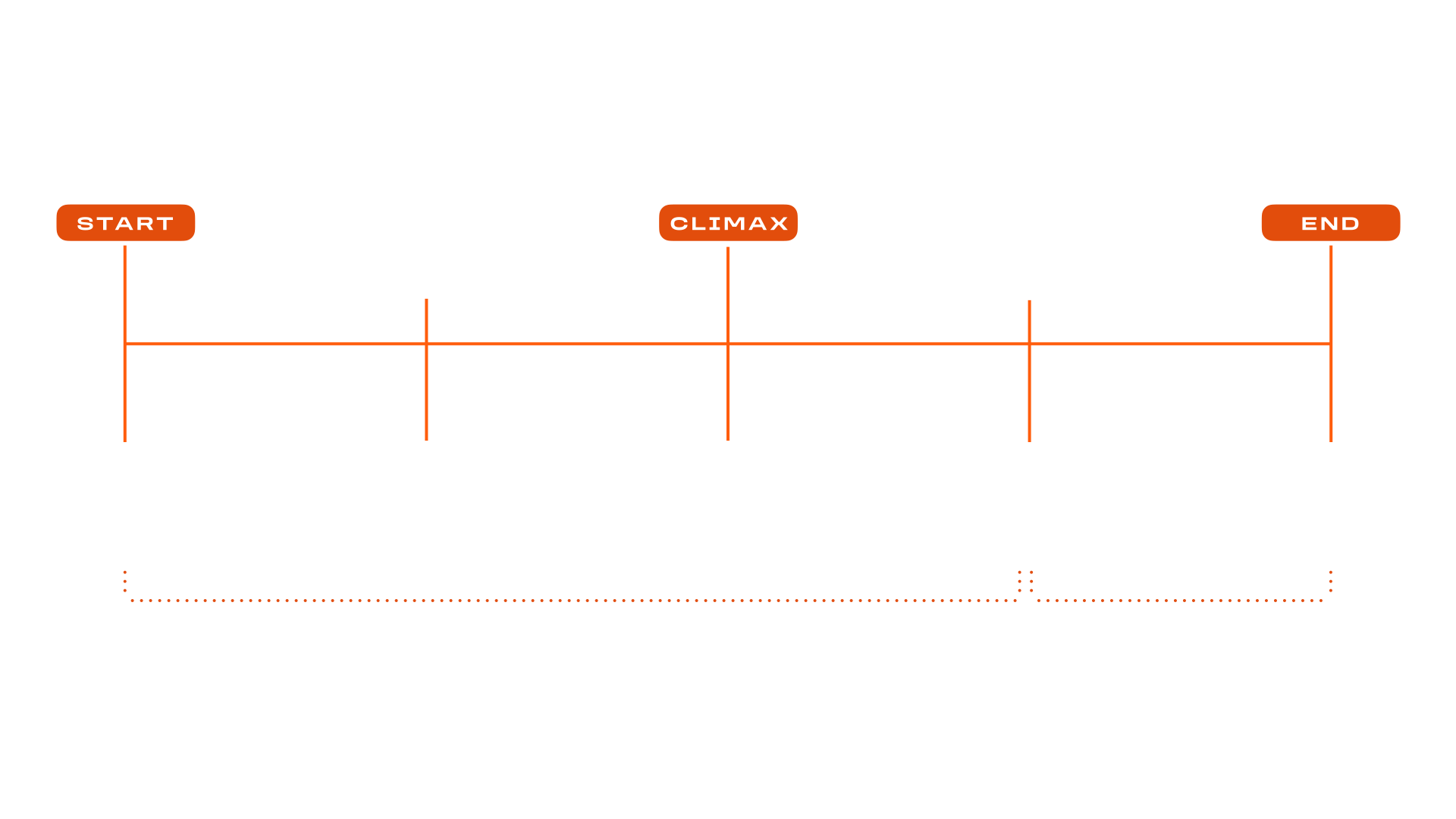
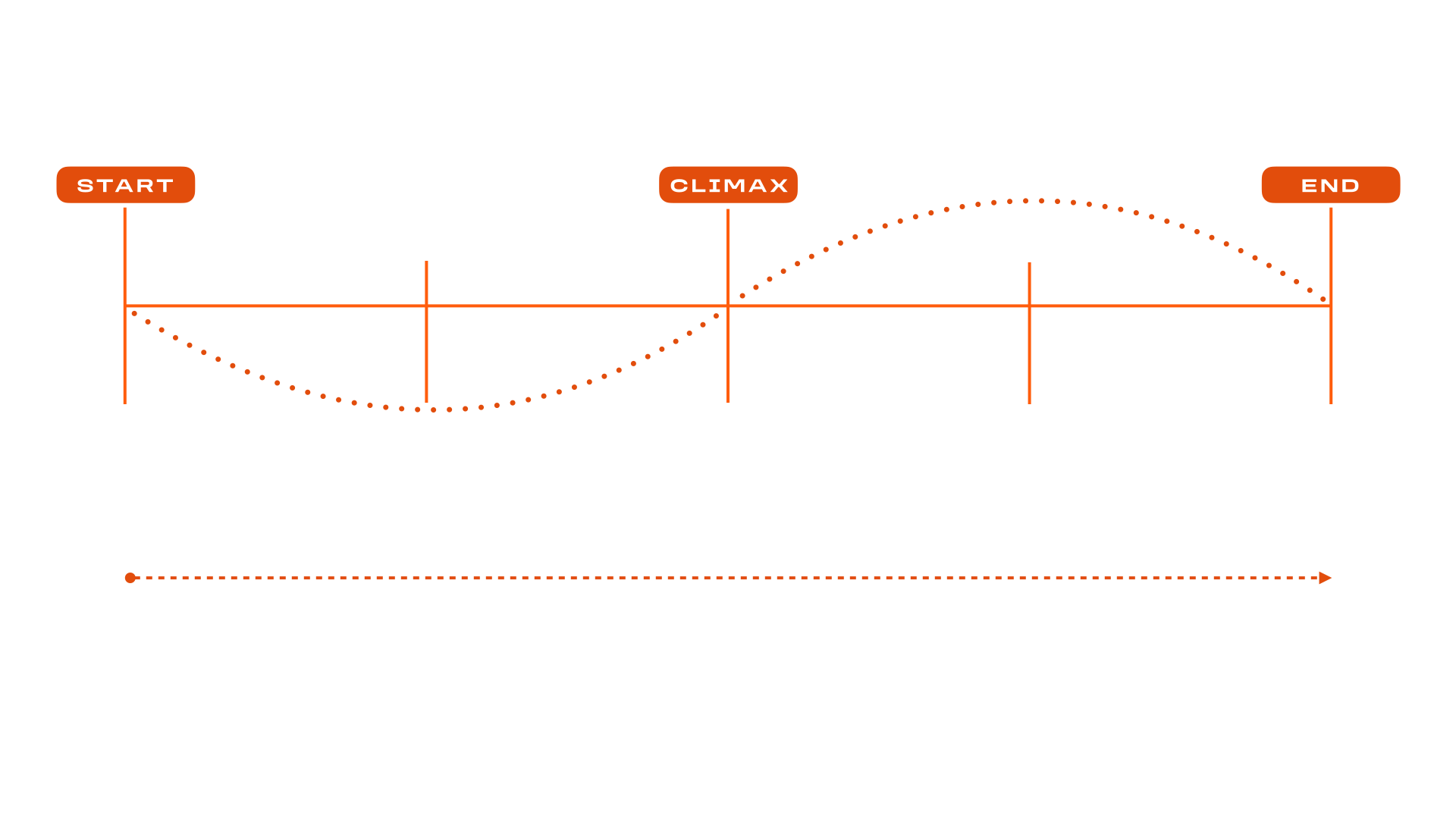
We asked the researchers to write out the dramatic points of rising tension in the conflict and to describe under the influence of which events, people, or circumstances the resolution of the conflict occurred (or did not occur). The researchers recorded what thoughts and feelings are experienced at the moment of catharsis for each storyline.